Industry: Protecting product integrity and reducing energy costs The number of tubes produced in Europe in 2018 reached 15.5 billion units. This…
ProblemYogurt production
Solution: The new Donaldson sterile filters offer a significantly longer service life while maintaining a high retention rate, which results in substantial savings.
Situation
Yogurt and dessert products account for a significant share of total dairy production. Annual per-capita yogurt consumption in Germany in 2016 was 16.8 kg (37 pounds). Danone's ACTIVIA is one of the best-known yogurt brands in the world. Production at the plant in Ochsenfurt am Main, Germany, is organized in compliance with the most stringent product-integrity requirements. Filtration is one of the core technologies in the sequence of biotechnological processes. To achieve high process reliability, a new series of filters for the sterile filtration of compressed air is used. The new filtration technologies have an important advantage in terms of savings: they significantly increase the filters' service life.

Industry: Spring water Problem: A producer may claim that its water has «natural purity» only if it meets certain requirements and…
Solution
In the spring of 2017, extensive testing of sterile filters for compressed air, fermentation air, carbon dioxide and other process gases was successfully completed at Donaldson's research and production facility in Haan, Germany. Our specialists managed to significantly extend the service life of the (P)-SRF sterile filter series while maintaining the high retention rate that is essential for protecting the integrity of processes and products. This success was made possible by the use of the latest filter materials, innovative processing methods and optimization of thermal resistance and mechanical strength. As a result, we created filters that take customers' requirements into account and comply with the strict requirements of international quality standards, as well as the company's principles aimed at using innovation and improving safety and environmental performance.
Thomas Karollus, an engineering consultant in the field of process filtration at Donaldson, proposed as the next step to hand the new filters over to Danone so that it could compare them in practice with the previous filter series. Over more than 20 years of joint work, a relationship of trust had developed between the filtration specialists of Donaldson and Danone, so a positive decision was made quickly. In July 2017, the gradual replacement of filter elements of the previous (P)-SRF and (P)-SRF N series with new sterile filters of the series began Thomas Karollus, a sales specialist at Donaldson, explains the filtration process in the tank room. The (P)-SRF C sterile filter is characterized by a high retention rate and a long service life. (P)-SRF C

Industry: Spring water Problem: A producer may claim that its water has «natural purity» only if it meets certain requirements and…
New sterile filters at the Danone plant in Ochsenfurt…
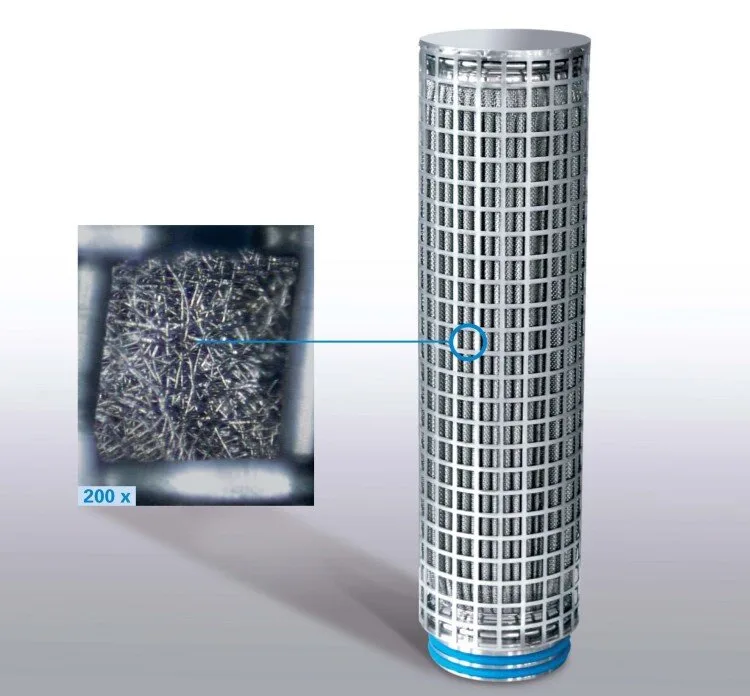
The (P)-SRF C sterile filter meets the most stringent requirements applicable in the pharmaceutical industry and in the production of food and beverages. In addition, the filter provides efficient filtration under harsh operating conditions. The (P)-SRF C filter element is a pleated depth filter with inner and outer sleeves and end caps made of stainless steel. The filter material, made by introducing PTFE into borosilicate, is wrapped in a protective PTFE fabric. The filter's retention rate exceeds 99.99999995 % for particles 0.2 microns in size and 99.99999995 % for particles 0.02 microns in size. According to testing in accordance with DIN EN 1822, the retention rate for nanoparticles (0.003 microns) exceeds 99.999999991 %.
All filter components meet the requirements for materials in indirect contact with food, in accordance with Volume 21 of the US Code of Federal Regulations and Regulation EC/1935/2004. No chemical additives are used in the production of the filter material. The robust filter design withstands more than 160 sterilization cycles at a temperature of 141 °C (290 °F) in both flow directions, and also allows other sterilization methods to be used, for example ozone or hydrogen peroxide in the vapor phase.
To appreciate the importance of these sterile-air filters, it is necessary to understand the yogurt production technology.
To appreciate the importance of these sterile-air filters, it is necessary to understand the yogurt production technology.
In fresh milk, the fat and protein content is adjusted. The milk is vigorously stirred to break the fat droplets into smaller particles and distribute them evenly throughout the milk. The milk is then pasteurized by heating to 90–95 °C (194–203 °F) for several minutes, followed by cooling to 40 °C (104 °F). The milk is then fermented using a special blend of five bacterial cultures.

Industry: Spring water Problem: A producer may claim that its water has «natural purity» only if it meets certain requirements and…
Thomas Karollus, a sales specialist at Donaldson, explains the filtration process in the tank room. The (P)-SRF C sterile filter is characterized by a high retention rate and a long service life.
The tanks are emptied by supplying them with highly purified sterile compressed air. At this stage the filtration system comes into action. The pressure of the compressed air, which is produced and dried at the central compressor station, is reduced to approximately 2 bar. The (P)-SRF C sterile filter ensures the sterility of the air and removes all particles from it. A high retention rate for bacteria, viruses and particles as small as 3 nm (nanometers) protects the integrity of processes and products.
Testing of the new (P)-SRF C sterile filters under a wide variety of operating conditions in the food and pharmaceutical industries has shown that they withstand more than 160 sterilization cycles. For sterilization, for example, a 20-minute cycle of passing saturated steam through the filter at a temperature of 131 °C (268 °F) in both directions can be used. The filter replacement interval recommended by Donaldson is 12 months.
Industry: Spring water Problem: A producer may claim that its water has «natural purity» only if it meets certain requirements and…
Filter sterilization with saturated steam
Sterilization of the filters at the Danone facility is carried out with saturated steam. This steam must also meet strict purity requirements, so it is passed through Donaldson steam filter elements of the series All filter components meet the requirements for materials in indirect contact with food, in accordance with Volume 21 of the US Code of Federal Regulations and Regulation EC/1935/2004. No chemical additives are used in the production of the filter material. The robust filter design withstands more than 160 sterilization cycles at 141 °C (290 °F) in both flow directions. и (P)-GSL N(P)-GSL N
The high quality of the steam extends the service life of the sterilized filters and reduces overall costs. Simple drying is another distinctive feature of the new (P)-SRF C sterile filters. Blow-drying and the immediate restoration of low differential pressure after steam sterilization takes just a few seconds. This makes it possible to significantly reduce downtime, lower energy consumption and reduce mechanical loads on the filter material.
The cooperation between Danone and Donaldson clearly illustrates how even minor changes can lead to a tangible economic effect. This is fully in line with the goals and objectives of Donaldson: safety, sustainability, innovation.
Important note