Author: Richard Juskowiak, Donaldson process filtration division
Reverse-osmosis filtration systems are used to purify water used in the production of food and beverages, pharmaceuticals and other consumer products. Since reverse-osmosis membranes are the main component determining product safety, and their replacement requires significant costs, it is important to protect them from biofilm formation. If bacteria survive the activated-carbon dechlorination stage, they multiply downstream, which leads to biofilm formation on equipment surfaces.
Industry: Spring water Problem: A producer may claim that its water has «natural purity» only if it meets certain requirements and…
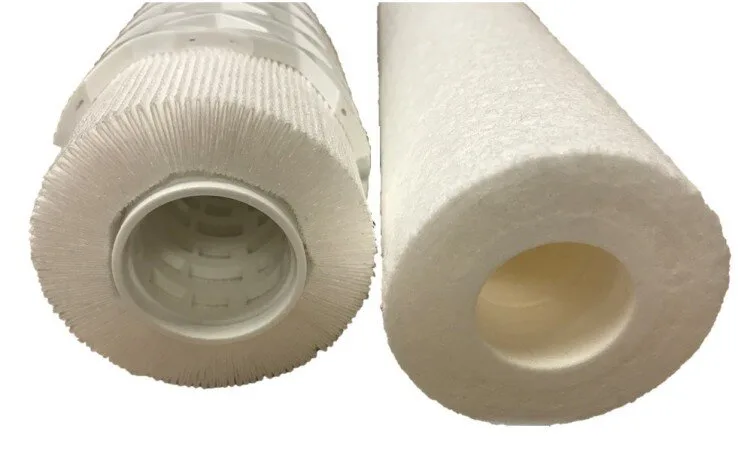
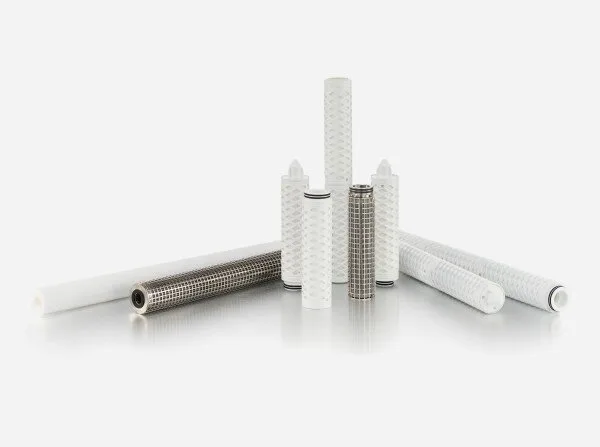
Pleated pre-filters (left) are characterized by an increased fabric surface area within the same volume as a filter with melt-blown filter material (right). The increased surface area of the filter material increases filtration efficiency and extends the filter's service life.
The degree of protection against biofilm formation in a reverse-osmosis system, as well as product safety and membrane service life, depends on the efficiency of the source-water pre-filtration. The US Food and Drug Administration (FDA) requires the pre-filtration of water before it is fed into reverse-osmosis systems. A deliberate choice of the type of pre-filter can provide additional benefits.
The service life of a reverse-osmosis membrane that is well protected from microbes and damage by carbon particles is usually up to two years. Failure of the membrane within a year may indicate an insufficient degree of pre-filtration.
Below are described three ways to increase the protection of the reverse-osmosis membrane using more efficient pre-filtration.
1. Pay attention to the composition of the filter.
Industry standards recommend using a 5-micron filter for pre-filtration in reverse-osmosis systems, but not all 5-micron filters are the same. For many years, the only option for producers was a filter made of melt-blown non-woven material. This is a polypropylene cylinder into which a non-woven polymer is injected. The random nature of this production process can lead to the formation of cavities and inefficient microbe filtration.
Thanks to the joint work of specialists in materials science, engineers and beverage producers, advanced filtration technologies have become available. Donaldson's LifeTec™ filters are distinguished by an improved filter-material structure and a housing with increased throughput and reliability.
The LifeTec filter material is folded inside a polypropylene cage, which, compared with elements made of melt-blown non-woven material, increases the filter surface area by 400 %, making it possible to retain more contaminants without reducing the flow.
The dense filter material has a structure with larger pores at the inlet; at the outlet the pores narrow. Such a funnel-shaped structure retains particles of a certain size and gives more confidence in the efficiency of the pre-filtration.
2. Look for filters whose efficiency can be verified.
When choosing a filter, pay attention not only to the size of the retained particles indicated in the supplier's data sheet, but also to the filtration efficiency. Efficiency is the percentage of particles in the size range indicated on the label that are guaranteed to be retained by the filter. Since there are no generally accepted measurement standards that filter manufacturers could follow, it is important to understand the nuances in this area. The filter's rating in microns and the terms "nominal" and "absolute" are quite relative, similar to how relative the "low-fat" claims on food products are.
To illustrate this feature, Donaldson tested melt-blown non-woven filters from five different manufacturers. All the filters claimed the retention of particles 1 micron in size and larger. Due to the non-uniformity of the melt-blown fibrous filter material, the spread of filtration efficiency ranged from less than 20 % to more than 98 %.
The new filtration technology makes it possible to achieve higher accuracy. For example, the efficiency of LifeTec filters can be verified using laboratory tests that Donaldson conducts for all its process filters.
An absolute-rated LifeTec filter that retains particles 1 micron in size and larger is guaranteed to filter out 99.98 % of particles 1 micron in size and larger. To confirm that its products meet the stated characteristics, Donaldson periodically re-tests the filters it produces and openly publishes the obtained values on all labels and in the technical documentation.
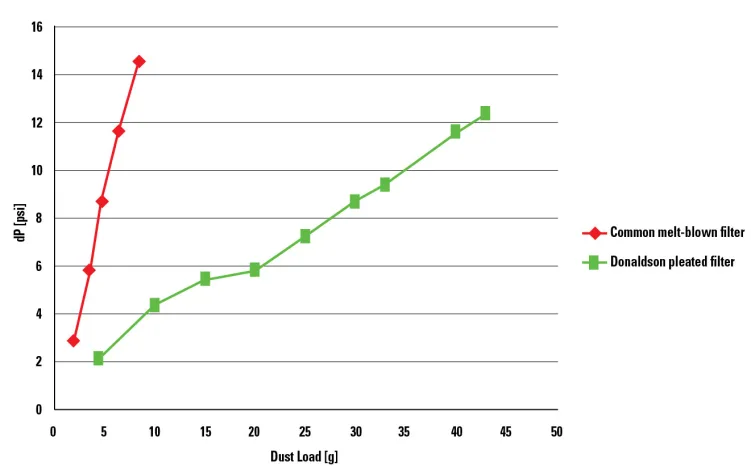
The dirt-holding capacity and increased throughput of the pleated filter
Industry: Spring water Problem: A producer may claim that its water has «natural purity» only if it meets certain requirements and…
3. Take long-term costs into account.
When taking a serious approach to preventing biofilm formation at minimal cost, the purchase price of a pre-filter should not be the only criterion. At many plants, melt-blown pre-filters for reverse-osmosis systems are replaced weekly. Such frequent replacements ultimately cost a tidy sum.
Industry: Spring water Problem: A producer may claim that its water has «natural purity» only if it meets certain requirements and…
The initial cost of purchasing modern pleated filters may be higher, but they make it possible to save significantly in the long term:
- increased protection efficiency doubles the service life of reverse-osmosis membranes;
- an increased filter replacement interval reduces downtime and maintenance;
- minimizing the risk of contamination thanks to the removal of microorganisms upstream.
You may also like…
Industry: Spring water Problem: A producer may claim that its water has «natural purity» only if it meets certain requirements and…
Filter elements
Donaldson offers filter elements for protecting the integrity of liquids and cartridge filter elements for improving product characteristics.
For optimal protection of the reverse-osmosis membrane, Donaldson's filtration specialists recommend installing a pleated absolute-rated 1-micron filter instead of a melt-blown filter, or directly after it. This will extend the service life not only of the reverse-osmosis membrane but also of the pre-filter itself, whose pleated filter material maintains a high throughput throughout its entire service life.
It is important for users to know that the manufacturer of the filters used tests its products and openly publishes data on the retention efficiency of particles of a certain size.