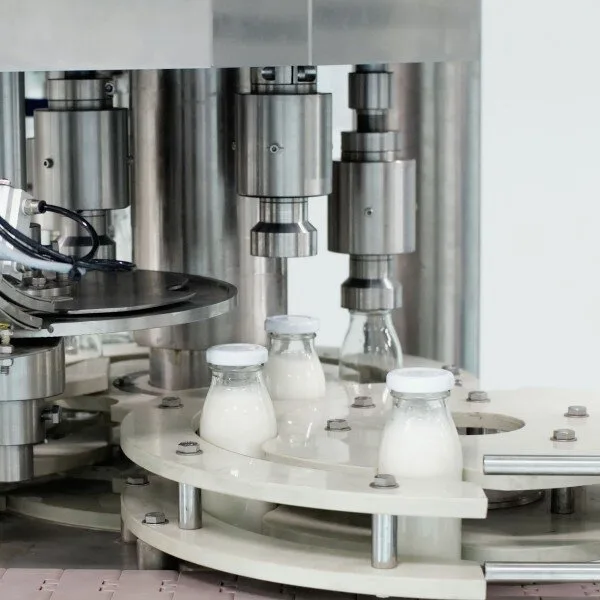
Filtration is widely used in beverage production, as well as in the food, pharmaceutical and other processing industries. Depending on the application, it is often necessary to maintain cleanliness at the production by using sanitary equipment designed and manufactured in accordance with certain standards.

Industry: Spring water Problem: A producer may claim that its water has «natural purity» only if it meets certain requirements and…
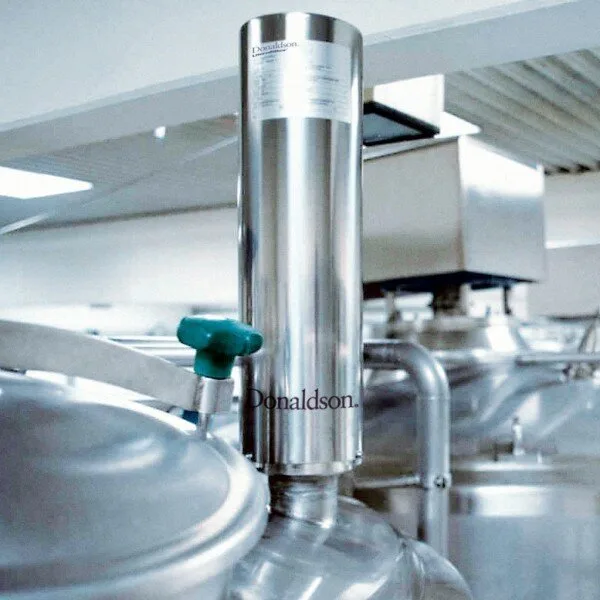
The PF-EG sanitary filter housing
What requirements must a sanitary filter meet?
The term "sanitary" is often confused with the term "sterile". ("Sterile" means the absence of living bacteria or other microorganisms. In accordance with Title 21 of the Code of Federal Regulations of the US Food and Drug Administration (FDA), a sterile air filter must not let through microorganisms with a reference concentration of 107 microorganisms per cm².)
"Sanitary" is a broader concept relating to health or its protection. A sanitary filter is designed and produced so as to hinder the growth of bacteria. The filter's design must ensure the possibility of cleaning all contact surfaces of the filter housing and easy disassembly of the housing for inspection and/or cleaning. Sanitary filter housings are made of materials that can be cleaned and that prevent product contamination. The surfaces of the filter housings are polished to a smoothness level of Ra 32 microinches, contain no defects such as cavities and cracks, have rounded corners that facilitate cleaning, and are equipped with clamps or other sanitary connections instead of threaded ones, in which contaminants can accumulate.
Industry: Spring water Problem: A producer may claim that its water has «natural purity» only if it meets certain requirements and…
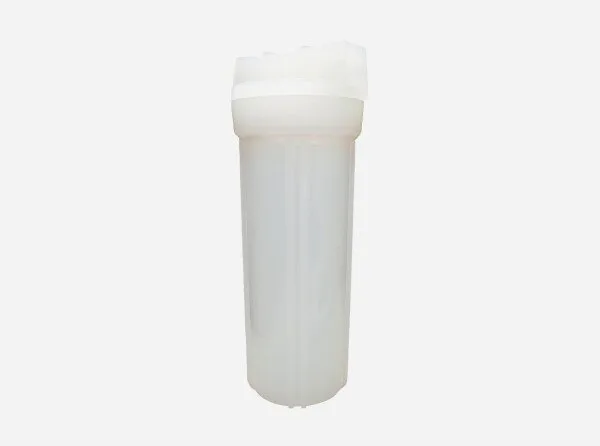
The PG-EG sanitary filter housing
In what areas are sanitary filters usually used?
Sanitary filter housings are usually used in systems requiring cleanliness. Filters that are designed, produced and certified as meeting sanitary-standard requirements are often used in beverage production, as well as in the food and pharmaceutical industries. Manufacturers often turn to industry organizations such as 3-A for the definition and establishment of sanitary standards.
You may also like…

Industry: Spring water Problem: A producer may claim that its water has «natural purity» only if it meets certain requirements and…
Food and beverages
Donaldson offers a wide range of products for a variety of applications, from pre-cleaning to sterile filtration in systems with a wide flow range.
What are the 3-A sanitary standards?
In the 1920s, with the development of the economy and consumer culture in the US, the need for stricter unified standards for dairy-industry equipment became obvious. Representatives of three interested parties — product manufacturers, sanitary inspectors and equipment manufacturers — jointly defined the first industrial standards for sanitary equipment. These standards were named "3-A standards", indicating the three interested parties. Representatives of these parties were at the origins of some of the largest modern industry associations, including the International Association for Food Protection, the Food Processing Suppliers Association, the International Dairy Foods Association and the American Dairy Products Institute.
Today, 3-A sanitary standards define the requirements for the design and production of equipment that comes into contact with food products. In total, 70 3-A sanitary standards and nine accepted 3-A practices have been defined. These standards are intended to protect food products from contamination and ensure the possibility of the mechanical cleaning of all surfaces in contact with food products, as well as their easy removal for inspection or manual cleaning.
3-A Sanitary Standards, Inc. is an autonomous non-profit organization. More than 360 companies in the US and 22 other countries have permission to use the 3-A marking on processing equipment of various types. Donaldson is proud to be among them.
You may also like…
Industry: Spring water Problem: A producer may claim that its water has «natural purity» only if it meets certain requirements and…
Pharmaceutical industry
Our filtration products ensure the highest level of cleanliness and protection in critical pharmaceutical-production operations, while being distinguished by a minimal cost of ownership.
How to find out whether equipment meets 3-A sanitary standards?
The simplest way is to find the 3-A marking on the equipment. Certificates for the 3-A marking for all authorized companies are available on the Internet. Currently, hundreds of companies offer equipment for food production; many of them claim compliance with 3-A requirements or include "3-A" in the name or model designation. Donaldson sanitary filter housings are not only designed and produced in compliance with 3-A sanitary standards but are also certified as meeting their requirements. Contact us for a list of Donaldson 3-A filter housings.