Some believe that compressed-air filters are intended only for removing dirt. This is undoubtedly an important function of a filter, but the main contaminant of compressed air is sometimes water in the liquid and vapor phases. This is often forgotten, because water in compressed-air systems can behave unpredictably — appearing and disappearing depending on the surrounding conditions and system parameters.
Donaldson offers products specially created for removing water in the liquid and vapor phases, as well as for the proper treatment and drainage of the collected water.
Stage 1: water removal
- Expansion: one of the ways to dry compressed air is to expand it. To use this method successfully, a Donaldson coalescing filter must be installed before the pressure regulator. The higher-pressure air above the regulator contains a large amount of water and a water aerosol. If this condensate passes through the regulator, it will evaporate and re-increase the air humidity. Depending on the system, it is also recommended to install a particle filter below the regulator, since a mechanical regulator can release contaminant particles that are able to disrupt the integrity of the process or the equipment.
- Cooling: to remove water, you can also cool the air using a refrigeration air dryer. As the air temperature decreases, the maximum possible content of water vapor in it decreases, which leads to condensate formation. In this case, it is important to protect the dryer from condensate or an oil emulsion using a Donaldson coalescing filter. Oil aerosols entering the dryer will quickly coat the tubes of the evaporator heat exchanger and reduce their flow and cooling capacity. Since condensate forms when the air is cooled in the dryer, a cyclone separator must be installed at the dryer outlet.
- Adsorption: to remove the maximum amount of moisture from compressed air, desiccants are used that adsorb the water vapors contained in the air flow. Designed for installation at the end points, Donaldson desiccant dryers are supplied with all the necessary pre- and fine filters for optimal system operation and obtaining high-quality air.
You may also like…
Industry: Spring water Problem: A producer may claim that its water has «natural purity» only if it meets certain requirements and…
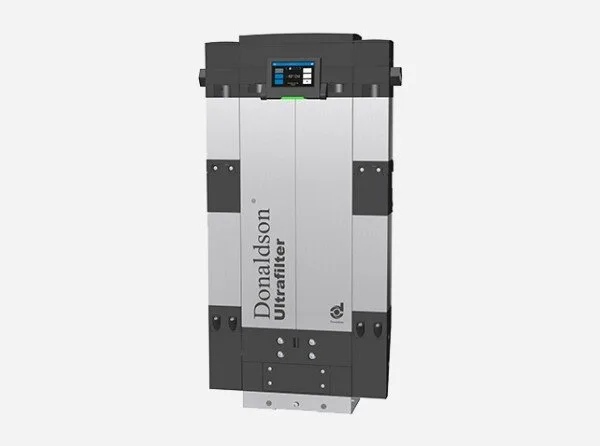
Dryers
Donaldson compressed-air dryers, which use different adsorption principles, can meet any air-quality requirements.
Stage 2: water draining
All the condensate formed during air drying, which is a dirty mixture of water, compressor oil and rust, must be properly disposed of. Due to constant changes in the surrounding conditions, the production load and the condition of the compressor, the use of a solenoid valve or a manual drain valve is unacceptable in most cases. These outdated methods are highly dependent on the accuracy of adjustment. A malfunction in the adjustment of such valves leads to significant energy losses or the filling of the filter with condensate. The Donaldson DF filter housing is equipped with a built-in float drain valve that automatically drains the accumulated condensate. The operability of the float drain valve can be checked during system operation by pressing the brass nipple at the bottom of the drain valve. To extend the service life and reduce energy consumption, a the loss-free Donaldson UFM-D condensate drain valve with electronic control. This easy-to-maintain external drain is equipped with a capacitive liquid-level sensor and a diaphragm valve with a solenoid, which ensure the economical drainage of condensate.
Stage 3: water disposal
Before disposing of the condensate in compliance with the norms, it must be treated. For this, all the condensate-drain lines are connected to the Donaldson UFS/DS series water-and-oil separator. The UFS/DS water-and-oil separator divides the collected condensate into clean water and waste oil. Upon entering the UFS/DS water-and-oil separator, the condensate is cleaned of solid particles. The cleaner water (in the lower part of the separator) is passed through an activated-carbon vessel to remove residual dissolved hydrocarbons and is then drained as purified wastewater.
Contact us for detailed information about all the moisture-control solutions mentioned in this article.