Author: Richard Juskowiak, Donaldson process filtration division
Food and beverage producers must, within limited time frames, ensure compliance with the requirements of the Food Safety Modernization Act (FSMA) by creating a Hazard Analysis and Critical Control Points (HACCP) plan or a Hazard Analysis and Risk-Based Preventive Controls (HARPC) plan. Perhaps you are currently modernizing your production processes. This is the most suitable moment to make changes to the existing filtration systems, on which food safety directly depends.
When analyzing the technological process and equipment pay special attention to the following two areas, where filtration is required first of all.
- Places of the initial formation and introduction of contaminants.
- Places where the system is subject to additional risks.
First of all, assess the utility systems and the places of production or storage of steam, compressed air and gases, for example nitrogen. These are the main sources of oil, moisture, contaminants and bacteria, especially when using air or water sources of questionable quality.
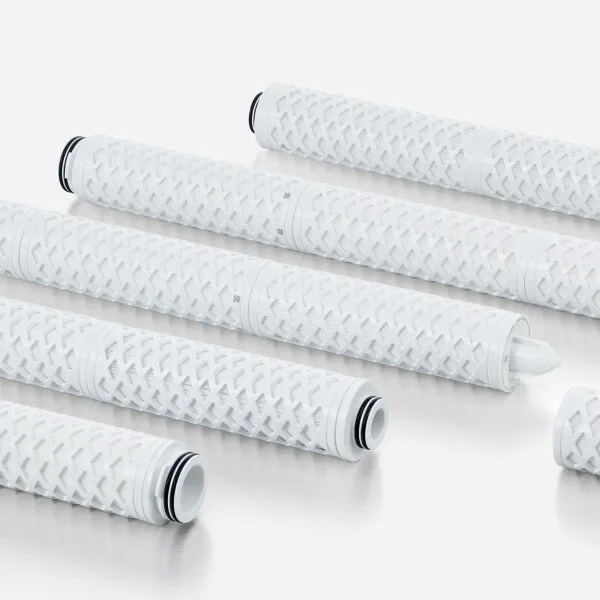
Plan the installation of pre-filters in such places. 10-micron filter elements retain large particles and 95–98 percent of all contaminants. This is an acceptable level of filtration for industrial systems, for example cleaning-in-place or sterilization-in-place (CIP/SIP) equipment. Pre-cleaning upstream will minimize downtime and the cost of replacing the expensive fine-fiber filters installed in the production line. To treat heavily contaminated spring or river water, an assembly of 50-, 20- and 10-micron pre-filters may be required. To clean contaminated compressed air, especially air in contact with food products, several pre-filters may be required.
Industry: Spring water Problem: A producer may claim that its water has «natural purity» only if it meets certain requirements and…
Unfortunately, it is not always possible to filter contaminants at their sources, so at the next stage it is necessary to determine the critical control points of the production line, in which there is a risk of introducing new contaminants or a risk of irreversible contamination. At such points of use, sterile filter elements with a rating of 0.2 microns or less should be installed. Below are examples of critical control points.
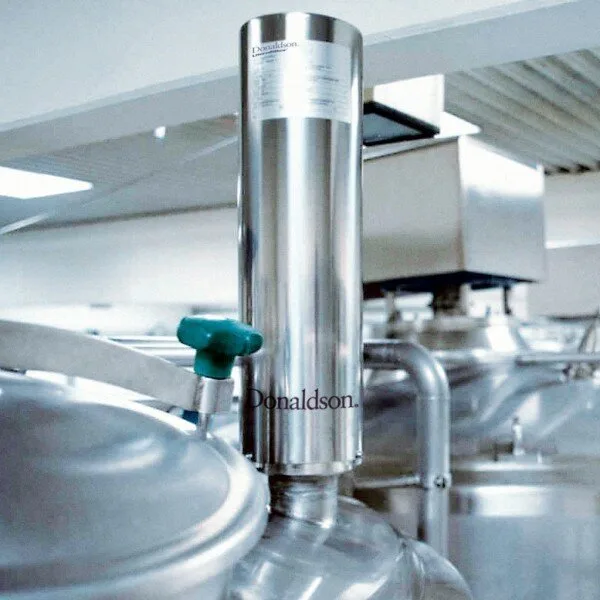
Mixing and storage tanks. Unwanted bacteria can multiply rapidly in such places. In addition, some products can spoil upon contact with oxygen. Before adding ingredients to a tank, it can be filled with an inert gas. Most often, nitrogen is used for these purposes. Nitrogen must be pre-filtered to remove contaminants that could have entered it from tanks, compressors and hoses.
Intermediate stages and ingredients. The introduction of ingredients and new processing stages in the production line are additional potential sources of contamination. At later stages, flavorings, spices, preservatives or emulsifiers can be introduced into the product. In the production of carbonated beverages, carbonation with carbon dioxide (CO2) is carried out. Choose filters for each new ingredient, as well as each new gas, steam and air used in processing the product.
Final processing and packaging. To remove any remaining contaminants, plan the installation of filters at the final-treatment stage. For example, in water-bottling lines it is recommended to use a membrane filter at the last stage. A risk of contamination also exists at the packaging stage. Packaging materials and seals in contact with food products or beverages must be scalded with culinary steam to kill microbes that could have gotten on them during transport or storage.
After choosing the appropriate installation locations filters, determine the condition of the existing equipment and the necessary filter elements. Find worn or faulty components, for example compressors, which often become sources of oil leaks. Flakes can peel off pipes and housings. Cracks can also form in them, in which contaminants are trapped.
Most standards and norms require the use of stainless-steel systems. However, even components made of this material that do not have a 3-A certificate can be sources of the following hidden risks.
- Low-quality welds with poorly finished areas.
- Shot-blasting of the surface instead of electropolishing.
- Pipe connections with a flange or National Pipe Thread (NPT) instead of sanitary connections, for example Tri-Clamp® sanitary clamps.
Industry: Spring water Problem: A producer may claim that its water has «natural purity» only if it meets certain requirements and…
Do not confuse a claim of compliance with 3-A standards with the presence of a 3-A certificate. Only certified equipment undergoes an independent check of compliance with the requirements for sanitary designs, in which the number of places for the accumulation and growth of bacteria is minimized.
Filter ratings can also cause confusion. The rating in microns is the particle size, which the filter is designed to retain. Efficiency is percentage of particles in the size range indicated in microns that are retained by the filter. To choose a suitable filter element, both of these parameters must be taken into account. For example, a value of 1 micron may be indicated on a filter's label. It would seem that this should be enough, but the efficiency of such a filter may be only 85 %. The reverse is also true. A 10-micron filter with an efficiency of 99.999 %, corresponding to a log reduction value of 5, has pores that are too fine for pre-filtration. It is also important to take into account the concepts "nominal" and "absolute" in relation to filters. An absolute filter material can achieve an efficiency of 99.98 % and higher, whereas a nominal filter has an efficiency of 60 to 98 % at the same retained-particle size.
Industry: Spring water Problem: A producer may claim that its water has «natural purity» only if it meets certain requirements and…
After determining the filtration efficiency and checking for a certificate, you can proceed to assessing the following parameters:
- the dirt-holding capacity (contaminant retention) of the depth filter;
- the number of sterilization cycles the element withstands without damage;
- the element replacement frequency (the filter's service life);
- a flow that ensures a reduction in energy costs.
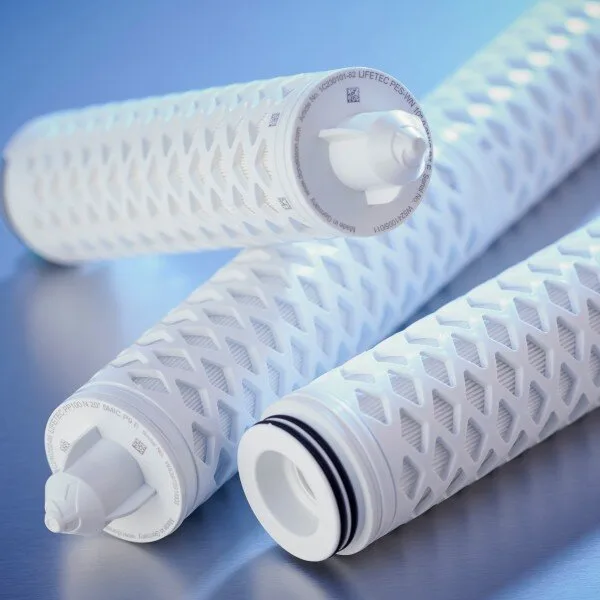
All these operational parameters of the filters determine the total cost of ownership of the system. A pleated cartridge filter for liquids with an increased initial cost can have a longer service life and ultimately reduce costs compared with a conventional melt-blown filter.
Industry: Spring water Problem: A producer may claim that its water has «natural purity» only if it meets certain requirements and…
The safety and cost-efficiency of a filtration system depends on the choice of filters with the necessary efficiency and retained-particle size and their proper installation location. Each technological process is unique in its own way. As a starting point when choosing a filtration system in each specific case, determining a filtration scheme can be recommended. Donaldson has developed several typical filtration schemes for food and beverage production. They can be downloaded for free on our website.
Process-scheme brochure: soft drinks ›
Process-scheme brochure: yogurt ›
Process-scheme brochure: cheese ›
Process-scheme brochure: beer ›